
The average Indian worker must labour for an extraordinary 160 full working days to afford Apple's latest iPhone 17 Pro.

'Marathwada is the suicide capital of Maharashtra.' 'To stop such man-made disasters, the government should immediately come up with a rightful package, not this charitable approach to compensation.'

Provisions in the Central GST Act say reduction in GST rates or the benefit of ITC must be passed on to consumers.

Congress leader Rahul Gandhi has said the 'wholesale attack on the democratic system' currently underway in India is the single biggest risk the country is facing, and asserted that allowing different traditions to thrive is very important as 'we cannot do what China does, which is to run an authoritarian system'. IMAGE: Kindly note that this image has been posted for representational purposes only. Photograph: / Rediff.com Speaking at a seminar titled 'The Future is Today' at the EIA University in Medellin, Colombia, Gandhi also alleged that there are 'huge amounts of corruption at a centralised level' in India now. "In India, we have huge amounts of corruption now at a very centralised level. So, three or four businesses taking over the whole economy, having a direct relationship with the prime minister, is rampant in India," the Leader of Opposition in Lok Sabha said. "But I believe decentralising power, making things more transparent, bringing people into conversations, and bringing people into processes is the best way forward," Gandhi said while addressing the seminar on Wednesday. Hitting back at the Congress leader for his remarks, the Bharatiya Janata Party on Thursday accused Gandhi of insulting and degrading India on foreign soil. Posting a video clip of Gandhi's speech on X, BJP national spokesperson Gaurav Bhatia said, 'Rahul Gandhi does it again, degrades India on foreign soil. From defaming our democracy in London, to mocking our institutions in the US, now in Colombia he spares no chance to insult Bharat globally.' 'This isn't dissent. It's disgrace to the fake Gandhi. Criticising BJP may be your right but dare you malign Mother India for your cheap and petty politics,' Bhatia said. Speaking at the seminar, Gandhi said India has a much more complex system as compared to China and its strengths are very different from that of the neighbouring country. India also has a very old spiritual tradition and a thought system with profound ideas that are useful in today's world, he said, adding that there is a lot that the country can offer in terms of tradition and way of thinking. "I am very optimistic about India, but at the same time, there are fault lines within the Indian structure. There are risks that India has to overcome. The single-biggest risk is the attack on democracy that is taking place in India," the Leader of Opposition said. "India has multiple religions, traditions and languages. India is actually a conversation between all its people. Different ideas, religions and traditions require space. The best method for creating that space is the democratic system," he said. "Currently, there is a wholesale attack on the democratic system in India, so that is a risk. The other big risk is different conceptions -- some 16-17 different languages, different religions... So, allowing these different traditions to thrive, and giving them space to express themselves is very important for a country like India.

While Congress and the states ruled by non-NDA parties pushed for the Centre meeting its statutory obligation of covering the deficit, the Union government cited a legal opinion to say it had no such obligation if there was a shortfall in tax collections. The Centre as well as BJP-JD-U-ruled Bihar were of the opinion that the states should borrow to make up for the shortfall in the tax revenues that have been compounded by the COVID-19 crisis, sources said.
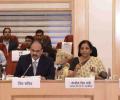
After the GST Council's meeting in March, the Centre had sought views from Attorney General K K Venugopal -- who is the chief legal officer of the government -- on the legality of market borrowing by the council to make good any shortfall in the compensation fund. The AG in his view said there is no obligation on the central government to pay the GST compensation shortfall, according to the sources.

GST Council decides to extend compensation cess beyond June 2022.

India's industrial production growth accelerated to a 4-month high of 3.5 per cent in July this year due to good performance of manufacturing sector, according to official data released on Thursday. The country's industrial output earlier recorded this level of growth at 3.9 per cent in March 2025.

Under the GST law, states were guaranteed to be paid for any loss of revenue in the first five years of the GST implementation from July 1, 2017.
The Centre has cleared the entire GST compensation payable till date by releasing Rs 86,912 crore to states, the finance ministry said on Tuesday. Of this, Rs 25,000 crore is released from the GST compensation fund and the balance Rs 61,912 crore is being released by the Centre from its own resources pending collection of cess. Of the total compensation released, Rs 17,973 crore is towards April and May dues, Rs 21,322 crore towards February-March dues and Rs 47,617 crore is the balance of compensation payable up to January 2022.
No longer a discretion of the tax administrator, the audit of returns filed by taxpayers is now based on a selection by algorithms, notes Tarun Bajaj.

Patanjali Foods has been served a show cause notice by the GST intelligence department, asking the company to explain why input tax credit worth Rs 27.46 crore should not be recovered from it. The yoga guru Ramdev-led Patanjali Ayurved Group firm, which is mainly into the edible oil business, has received the notice from the Directorate General of GST Intelligence, Chandigarh Zonal Unit, according to a regulatory filing made by the company on April 26.
The GST Council on Saturday clarified that guarantees provided by corporate to their subsidiaries will attract an 18 per cent GST, while no tax will be levied if a personal guarantee is given by a director to the company. The council, chaired by Union Finance Minister Nirmala Sitharaman and comprising state ministers, also cut the GST rate on molasses to 5 per cent from 28 per cent. It also ceded the right to tax Extra Neutral Alcohol (raw product for making alcohol for human consumption) to the states.
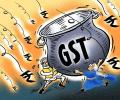
The Goods and Services Tax (GST) Council, which is likely to meet in the third or fourth week of June, is set to clear the operational framework of the much-awaited GST appellate tribunal, which will deal with tax disputes and streamline resolution. "The final blueprint, mainly the operational part, is expected to be presented in the GST Council meeting for approval. "This will pave the way for the tribunal to be functional, both at the central and state levels," said a senior government official, who expects the tribunal to be up and running by November.

The Congress party has accused Union Minister Nitin Gadkari of conflict of interest, alleging his sons' companies have benefited from the government's ethanol blending policy. The BJP has rejected the allegations.
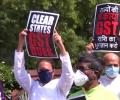
Dissenting states including Chhattisgarh and Kerala, have made it clear they are in no mood to relent. They want the Centre to borrow the entire Rs 2.35 trillion this fiscal citing bleak fiscal position.

Only after its recommendations will the central GST, integrated GST and state GST Bills be taken up

States are planning to pass resolutions in their legislative assemblies; however, such tactics will be used as the last resort if the Centre continues to stall allocations.
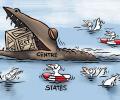
In signs of acceleration in economic activity, India's tax collections on goods sold and services rendered returned to over Rs 1 lakh crore in July after the second wave of Covid-related restrictions caused a blip in the previous month. Goods and Services Tax (GST) mop-up grew 33 per cent year-on-year in July to over Rs 1.16 lakh crore, indicating that the economy is recovering at a fast pace. In July 2020, the collection was Rs 87,422 crore. This is the second highest collection so far this fiscal after a record Rs 1.41 lakh crore mop-up in April.

The textile and apparel sector is India's second-largest employment provider, after agriculture, and it is now caught in a wave of uncertainty following the Donald Trump administration's tariff policy.

'This year's detection of frauds and probable recovery will be mainly driven by several compliance measures put in place, and amendments made to the GST regime to plug revenue leakages particularly in new-edge sectors.'
Continuing the upward trend, GST collections rose 10 per cent to about Rs 1.64 lakh crore in December compared to Rs 1.49 lakh crore in the same month a year ago. During the April-December 2023 period, gross Goods and Services Tax (GST) collection witnessed a robust 12 per cent growth, reaching Rs 14.97 lakh crore against Rs 13.40 lakh crore mopped up in the same period of the previous year, the finance ministry said in a statement on Monday. The average monthly gross GST collection of Rs 1.66 lakh crore in the first nine-month period this year represents a 12 per cent increase compared to the Rs 1.49 lakh crore average recorded in the corresponding period of FY23, it added.
GST collections jumped 15 per cent to nearly Rs 1.68 lakh crore in November, the finance ministry said on Friday. Goods and Services Tax (GST) mop-up was over Rs 1.45 lakh crore in November 2022.

Food delivery major Zomato has received a Rs 401.7 crore show cause notice from the Directorate General of GST Intelligence (DGGI) over 'unpaid taxes' on delivery charges collected from customers, the company said in a regulatory filing late on Wednesday. The company claimed that it is not liable to pay the penalty for the period from October 29, 2019, to March 31, 2022, as the amount collected from customers is "on behalf of the delivery partners during the referred period."
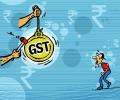
The broad trends of GST collections will make you wonder if indeed the biggest indirect tax reform in the country has led to a real improvement in revenues, notes A K Bhattacharya.
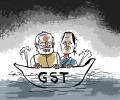
If the items and services such selected subsequently pass the test from the fitment committee and the GST Council, this would be the first of such rate hikes, after a series of cuts in the process of rate rationalisation that started in November 2017.

Goods and Services Tax (GST) collections at Rs 95,480 crore in September touched the highest level so far this fiscal, the finance ministry said on Thursday.
Economic Advisory Council to the Prime Minister (EAC-PM) chairman Bibek Debroy on Tuesday said the government was losing revenue due to the GST, which should be revenue neutral with a single rate. Speaking at an event organised by the Calcutta Chamber of Commerce in Kolkata, he however said that GST has led to a lot of simplification. "The ideal GST is one that has a single rate, and it was meant to be revenue neutral.
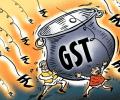
One of the grey areas is whether the anti-profiteering provisions can provide for a comparison of tax rates between the pre-GST and post-GST eras, says Niraj Bagri.

The data primarily pertains to activities in March, which had only a few days under the Covid-19 lockdown. For April , hence, CGST collections could be much lower, fear analysts.

The Central government will borrow up to Rs 1.1 lakh crore on behalf of the states to bridge the shortfall in GST collections, the finance ministry said on Thursday. A slowdown in the economy since last fiscal has resulted in a drop in the Goods and Services Tax (GST) collections, upsetting the budgets of states which had given up their right to levy local taxes such as sales tax or VAT when GST was introduced in July 2017. To make up for the shortfall, borrowing from the market was proposed.
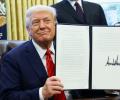
The Trump trade shock is a chance to push long-overdue reforms, rather than tinker with tariffs to appease the US, suggests M Govinda Rao.
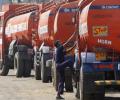
While the Centre is criticised for not cutting excise duty on petroleum products, it is the states which gain more from the rise in their prices

GST revenue remained above Rs 1 lakh crore for the second straight month in August at over Rs 1.12 lakh crore, 30 per cent higher than the collection in the year-ago period, the finance ministry said on Wednesday. "The gross GST revenue collected in the month of August 2021 is Rs 1,12,020 crore of which Central GST is Rs 20,522 crore, State GST is Rs 26,605 crore, Integrated GST is Rs 56,247 crore (including Rs 26,884 crore collected on import of goods) and Cess is Rs 8,646 crore (including Rs 646 crore collected on import of goods)," the finance ministry said in a statement. The mop up in August is, however, lower than Rs 1.16 lakh crore collected in July 2021.

The growing rift between MSIL and rival automakers has complicated the government's efforts to finalise the CAFE norms.

Thomas Isaac has been in and out of the national news in his role as Kerala's finance minister since 2018 for various path-breaking tax initiatives. But it is 2020 that he has become more prominent, principally in the GST council.

School students in Rajasthan will no longer study two-part supplementary textbooks with state Education Minister Madan Dilawar arguing that these reading materials are not required because they glorify the Nehru-Gandhi family and carry no marks for students.

Mrs Gandhi's power ebbed and peaked with the times. Mr Modi's has almost been constant, barring the few months of hard dip after the 240 seats of 2024, points out Shekhar Gupta.
The shortfall in GST compensation payable to states in the current fiscal is estimated at Rs 2.69 lakh crore, of which Rs 1.58 lakh crore would have to be borrowed this year. The Centre expects to collect over Rs 1.11 lakh crore through cess on luxury, demerit and sin goods which will be given to the states to compensate them for the shortfall in revenue arising out of GST implementation. The remaining Rs 1.58 lakh crore would have to be borrowed to meet the promised compensation to states under the Goods and Services Tax (GST) regime.

'Today, we have 2 million active drivers earning through our platform every month.'
